
Anselm
On Wim Wenders' 2023 documentary, and the Anselm Kiefer: Becoming the Sea exhibition at the Saint Louis Art Museum

Anselm opens with a sweeping shot of a dress mounted on a plateau. Tactile white folds cast in combinations of plaster, resin, and bronze stretch across the rocky ground. The sun rises as the frame quietly fades to different camera angles, and the shadows the dress was previously drenched in are erased by brilliant light. The scene turns, chirping birds and calm nature sounds give way to a heady choral score, and the camera sweeps across another part of the landscape and eventually into the blindingly bright interior of a cavernous warehouse; more headless, armless dresses, each with a different item sitting atop them. The music is backed by indecipherable whispering, casting a mysterious mood over the scene that transforms each gown into not only a mere item, but as a ghost of the person it’s intended to embody.
German artist Anselm Kiefer’s sculpture series “The Women of Antiquity” recognizes notable women from ancient history, all rendered in white gowns, their heads replaced by items that mark their identities: a long leather whip for Eulalia, a martyred Christian from Barcelona who was brutally whipped; a pile of sticks for Thusnelda, a Germanic tribal queen who hailed from the forest; a stack of lead books for the Greek poet Sappho, who is now celebrated as a queer icon. The resulting interpretation of each piece is two-fold: paying tribute to powerful women who history has largely erased, while also demonstrating that erasure through the absence of a corporeal form, the object that defines their legacy or their fate overshadowing their presence.
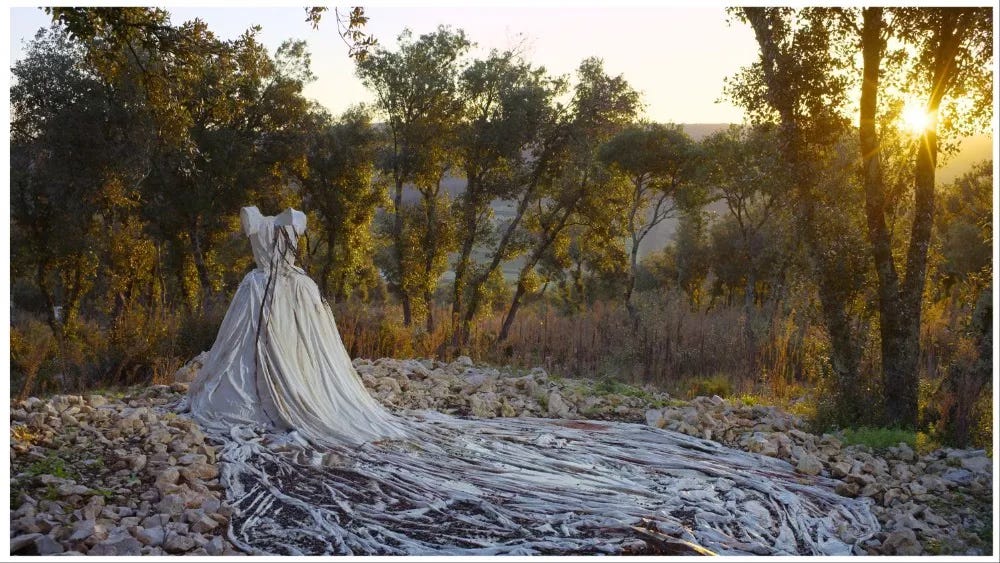
Wim Wenders’ 2023 documentary patiently unfurls, uniting Kiefer’s life and work in hushed tones and stunning portraiture, shot in 6K resolution. It’s the sort of slow, abstract art movie that I could easily see myself dozing off to at a 10 PM screening on the fifth night of a film festival; just that opening sequence featuring “The Women of Antiquity” clocks in at close to ten minutes. Despite the minimal context the film provides, it’s beguiling all the same. So imagine, having just watched Anselm for the first time earlier that morning, the thrilling shock I felt as I rounded the corner entering gallery 251 at the Saint Louis Art Museum to gaze upon a selection of “The Women of Antiquity” scattered throughout the room— Eulalia and Thusnelda and Sappho, but also Melancolia with her transparent polyhedron noggin and Arria with her sacrificial emblem, a tangled bundle of thorny vines— close enough for me to touch, the mid-afternoon sun of a late November day streaking through the floor-to-ceiling windows that comprise the room’s west-facing wall, saturating the gowns in dramatic lighting befitting of the figures they represent.


“The Women of Antiquity” are just one piece of Anselm Kiefer: Becoming the Sea, a staggeringly impressive exhibition on view at the Saint Louis Art Museum (abbreviated as SLAM) now until January 25. Kiefer’s first major American exhibition in 20 years, the exhibit is part retrospective, part site-specific installations largely centered on the role of rivers and waters in his work— vessels for memory and spiritual cleansing. The latter, consisting of five unspeakably massive paintings, greets you as soon as you walk into the Sculpture Hall that generally serves as the lobby of the museum’s main building. If you’ve never been to SLAM, allow me to attempt to paint a picture for you. The magnificent three-story structure was constructed to serve as the Palace of Fine Arts for the 1904 World’s Fair, with two wings stretching out on each side. The entry hall isn’t typically utilized as a gallery space, but I imagine it, where the walls reach from floor to ceiling unobstructed, is the only place in the museum where Kiefer’s paintings could be mounted. I don’t know the exact dimensions of the canvases, but they reach from the floor very near to the ceiling; certainly well past the top floor, judging by the placement of the landing that allows you to gaze out over the hall from above. Desks, everything save some seating, has been pushed from the center of the floor, granting space for patrons to walk through and savor the works, all inspired by rivers and all realized in blue, green, and brown hues accented with gold leaf that shimmers as you stroll by them. Two of these pieces, “On the Rhine” and “Anselm Was Here,” are inspired by the rivers he was born near in Germany and grew up near in France. Kiefer commonly integrates poetry into his pieces, scrawling stanzas in rough cursive across the tops of his paintings; it speaks to the striking nature of the bold visuals he crafts that this technique doesn’t so much spoon-feed a literal interpretation of his work, but rather creates a dialogue with his inspirations, situating his pieces in a specific context. One of these paintings, “For Gregory Corso,” whose 1981 poem the title of Kiefer’s exhibition is derived from, ponders the spiritual connection to water, as waves stretch out toward the horizon under the arch of Corso’s words (“spirit is life like a river unafraid of becoming the sea”). The last two paintings, “Missouri, Mississippi” and “Lumpeguin, Cigwe, Animiki,” are specifically linked to Missouri and the Midwest and a 1991 trip Kiefer took to St. Louis, during which he traveled up the Mississippi by boat; spirit beings from the region’s Native peoples dance in a swirl above and among the river’s choppy waves. The exhibition continues in SLAM’s East Building, a modern expansion opened in 2013 that stands in stark contrast to the grand antiquity of the original structure and that is typically used to house the museum’s temporary exhibits. This is where Kiefer’s sculptures are, and smaller paintings, and woodcuts, and books of his photography.
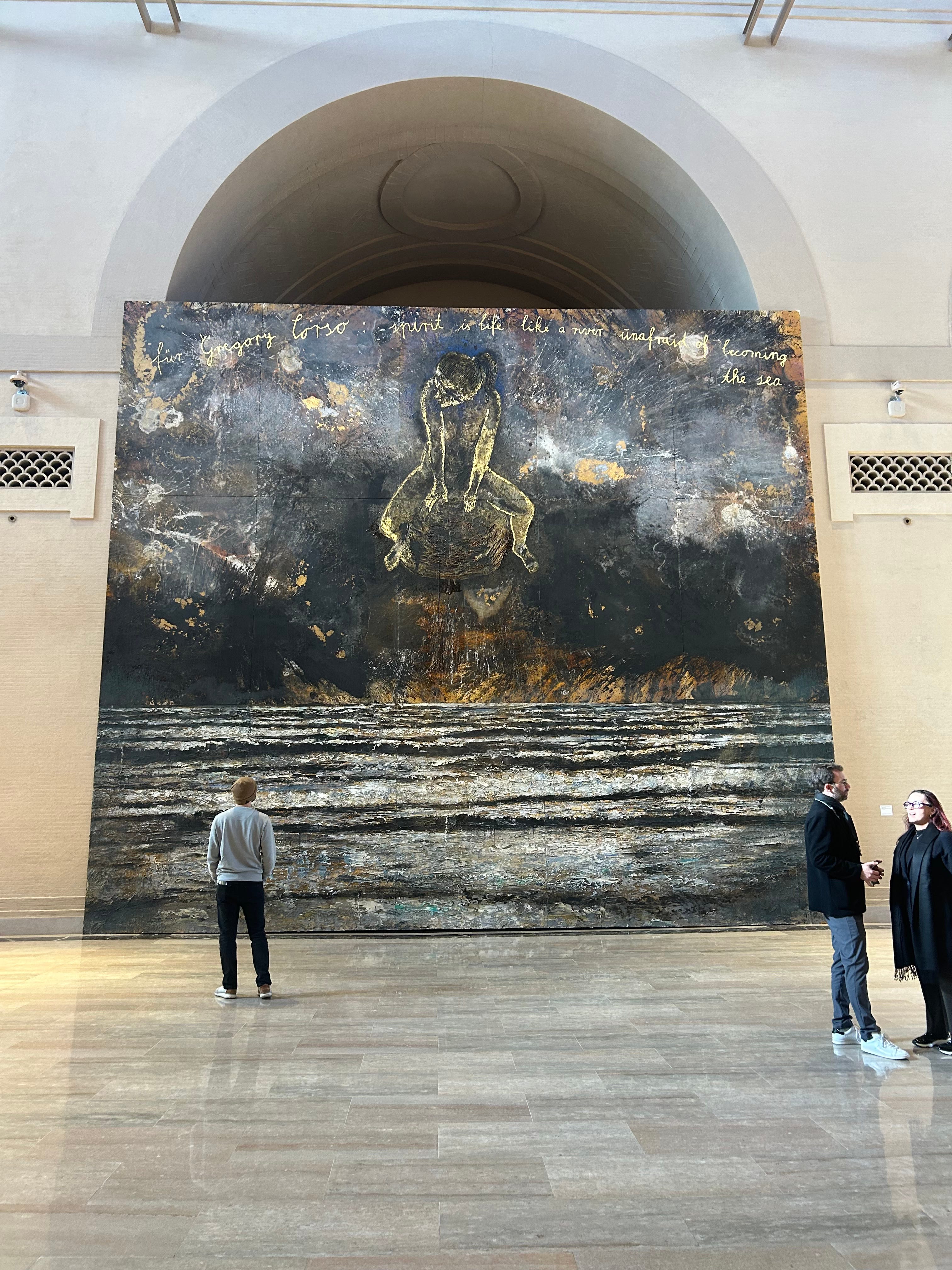
The overall impression of the exhibition— which contains works from the 1970s through today— is that of an artist whose methods are continually evolving, who is daring in his experimentation with unorthodox materials. You have to take multiple approaches to viewing his art to fully absorb it: from far back, to comprehend how all the elements cohere into one unified whole, and from close up, to parse through all those elements individually (the physical copy of the exhibit’s visitor guide actually contains a viewfinder you can tear out to aid in focusing on specific segments of the work). Impossibly think globs of paint streaked with color, straw and wire, shimmering blue-green sediment gathered from electrolysis (a process of oxidizing copper by submerging it in a salt bath and applying an electric current to it). It wasn’t until my face was within inches of the canvas that I realized that Kiefer’s painting “Becoming the Sea” (another tribute to Gregory Corso) contained actual stones attached by wire and nails.
The tactility of Kiefer’s work is essential to it, and that’s something that Wenders voices in his documentary, stating that there are parts to his paintings that you can really grasp just viewing them flat, as in a photograph. Perhaps that’s why he chose to shoot and theatrically release Anselm in 3D. SLAM actually hosted a weekend of free screenings of the film presented in 3D, but alas, I was unable to attend. I’m sure it’s a worthwhile accent to the movie, but perhaps because I had the opportunity to view so many of the pieces depicted in the film in reality, I don’t feel like I was missing much watching it on my TV at home. I could also easily discern which parts the 3D would be most effective; shots are often composed with a clear foreground, middle ground, and background, while an animated interlude depicting scenes of Kiefer’s early life styled like layered woodcuts would clearly also pop further with the 3D effect applied. In any case, Anselm had been loitering in my watchlist every since it was released, and I’m glad that the exhibition gave me not only the impetus to finally watch it, but informed how I engaged with the art. Wenders— who befriended Kiefer around 1991 after a chance meeting in a restaurant— dreamed of being a painter when he was younger (in a Meet the Filmmakers interview on the Criterion Channel, he describes watching Kiefer as creating a “strange pain in my heart, because that’s the life I always wanted to live”); he may not have ventured into that territory, but he’s similarly experimental with his chosen medium, moving from narrative features to documentary to commercials and music videos to still photography. His themes also similarly confront the ramifications of Germany’s complicated past and present (Wenders’ 1987 fantasy Wings of Desire depicts a Berlin still divided by the Wall, and the isolating impact that has on the city’s inhabitants). Anselm perhaps props its subject up with too much reverence, while simultaneously holding him at a distance. We’re given little sense of Kiefer’s personality from the film; he’s often seen in obviously staged vignettes, like reading poetry by Paul Celan, one of his key influences (Celan was a German-speaking Jew who survived the Holocaust; that trauma is a major factor in his linguistically-innovative verse) in his studio, audio of roaring plane engines layered over the shot. The most introspective moment he’s allowed arguably comes toward the end of the film, when Kiefer claims that, even after all these years, he still doesn’t feel like he’s “arrived.”

But it stands as an epic confluence of two great artists. Kiefer, who was born in 1945, in the waning days of World War II, was one of Germany’s first artists to really reckon with the Holocaust and the country’s dark history and attempt to reclaim iconography hijacked by the Nazis. Anselm, which is loosely divided into segments centered around Kiefer’s different studio spaces over the years, slips between archival footage that alludes to his early accomplishments (receiving an art degree and touring areas closely associated Vincent Van Gogh) and later controversies, dreamlike reenactments that flash back to Kiefer’s early childhood as a curious little boy and later a young adult in the 1970s (Wenders’ grand-nephew Anton Wenders plays Kiefer as a child, while Kiefer’s own son Daniel Kiefer plays the younger iteration of him, giving the scenes close personal ties to both the director and his subject), and new footage of Kiefer at work in his studio. Watching Kiefer at work is perhaps the greatest pleasure to be derived from the film. Aerial drone footage depicts the vastness of his studio, located in a large hangar in Croissey-sur-Seine, just outside Paris; surrounded by the products of his imagination, Kiefer traverses the space on a bicycle. He works on such a large scale, he often mounts a lift to reach the top of his canvases. Wenders is such an immersive filmmaker, that we still get a clear sense of Kiefer’s textures; the squish of the paint as he mixes it with a large palette knife, the wet thwap as he slaps it onto the painting’s surface, or the crackle as he sets fire to straw attached to canvas. Dissolves link all these segments together; in one scene, as the image of a painting fades into archival interview footage, the former temporarily gives texture to the latter. In another sequence, the ruinous facade of one of Kiefer’s large scale installations is superimposed over footage of his demolished hometown in the aftermath of World War II, providing a succinct and effective link between his art and his life.


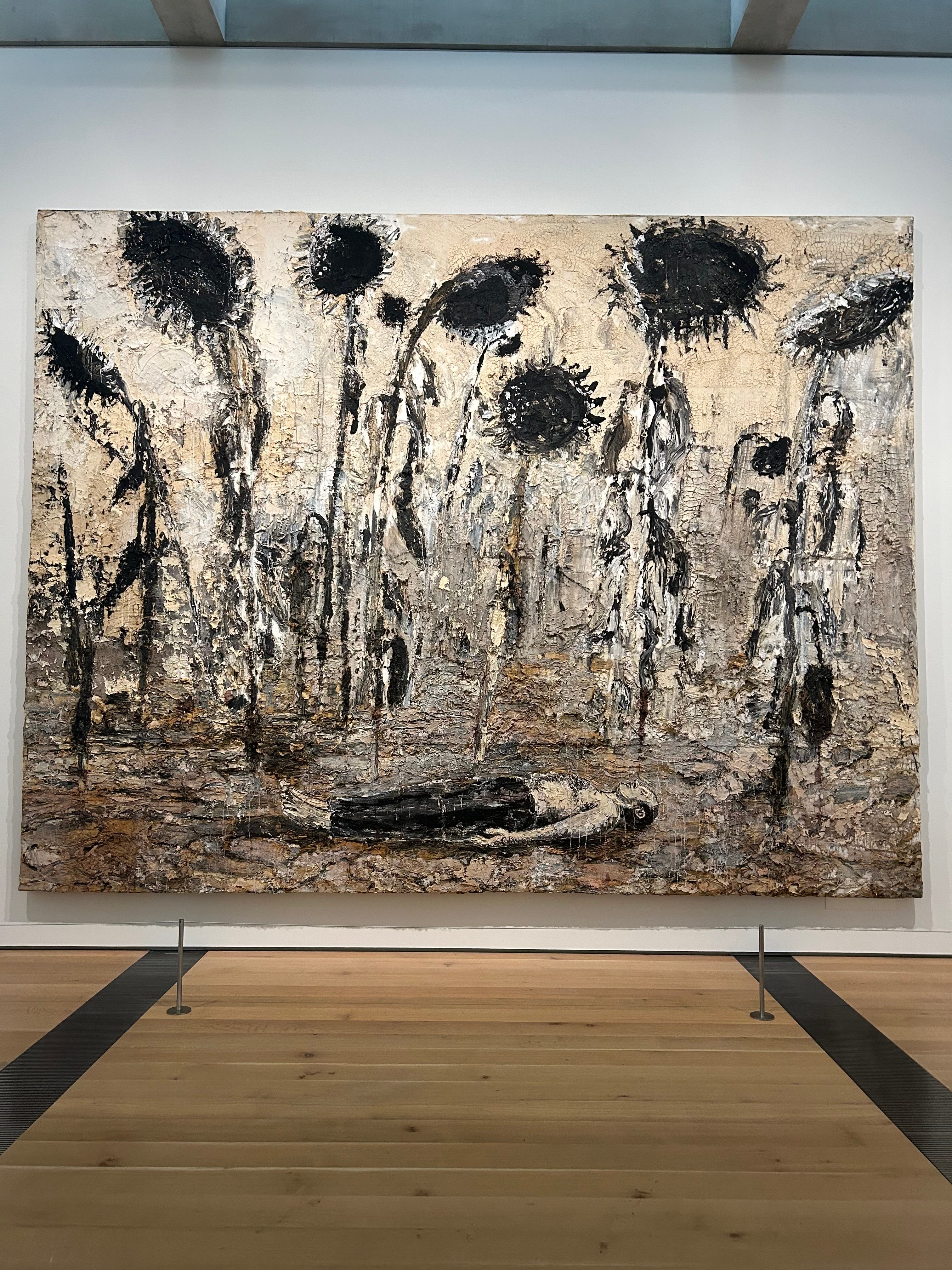
The final work displayed in the SLAM exhibition is Kiefer’s 1996 painting “The Orders of the Night.” This painting depicts Kiefer lying on the ground in a corpse pose beneath a canopy of black sunflowers; its title is derived from a 1956 poem by Austrian poet Ingeborg Bachmann (an associate of Celan, similarly shaped by Europe’s postwar landscape) called “To the Sun.” This painting also appears at the end of Anselm, when a recreated scene showing Kiefer as a child lying down in a bed of sunflowers fades into that very painting, which possesses a sort of melancholic beauty; cheery flowers that typically reflection light are rendered as black holes that absorb it. To watch Anselm isn’t so much to learn about the artist, as it is to experience his art in another way. As much as it stands on its own, the film is a remarkable supplement to an essential cultural event currently occurring, to quote Judy Garland’s Esther Smith, “right here in St. Louis.” I like to think that I’m a richer person for having experienced both.
Anselm is currently streaming on the Criterion Channel and Kanopy, and is available to rent or buy on all digital platforms, as well as on disc from Criterion.